
Founders’ Generation Period (1871-1890)
In the 19th century, geographical territories that were to become Germany in the future were not like the unified German empire of 1871 or the modern federal Republic not known to the contemporary world. It was termed as “geographical expression” because Germany was not to achieve unification in the company of great powers.
The political and constitutional structure of Germany was a loose Confederation before the emergence of an empire in 1871 consisted of independent states known as the “Holy Roman Empire Of the German nation “.
But Napoleon disrupted the whole system and gave ruling positions to his relatives. At the time of the Congress of Vienna Prince Clemens von Metternich took it upon himself to resist Napoleon’s modifications. The German Confederation emerged on the scene which had 89 principalities and 5 cities in this group. Five states had the power to influence in the configuration matters independently which were Southern states of Baden, Wurttemberg, and Bavria. Also, there were two larger entities: Prussia and Austria. However, Metternich’s authoritarian policies continued, and he sported the Princess of stairs who were harnessing their own benefits from the system, but they were shaken by the revolution of 1848-1850.
For a time being rulers got afraid of popular mass movements unrest allowed the elected assemblies to draft
constitution that would assimilate Liberal ideas of elected government and free enterprise. The revolution reached its peak when the delegates met at the church of Saint Paul in Frankfurt. But the revolution failed because the delegates at Frankfurt were unable to solve the pressing issue of greater Germany and smaller Germany. People in the camp of greater Germany wanted to include German speaking parts of the Austrian empire while those in the opposition camps did not want Austin to become part of United Germany. Best only order of Princess rule was restored more than ever Prussian King Frederick William IV had broken my promise and he claimed, “Prussia will be absorbed by Germany”. But in the process a new political division was created between Northern and Southern states. So, there were Southern States (Lander) who kept a few liberal ideas while Northern states under the leadership of Prussia became stalwart proponents of authoritarianism.
Prussia considers itself the champion of conservative groups and begins to follow the road to a constitution that would strengthen the rules of conservatives in the largest states of Germany. To counter the revolution the key strategy was the electoral system devised by the state. It was a three-class system limited to male members of 25-year-old or older. In each class system members were determined by the amount of Direct tax paid. Second class consisted of those who paid the next third part of the revenue and the third class of voters consisted of those who contributed to the last third part of the revenue. This twisted system was designed to favor the rural and urban rich which was advantageous to the conservative candidates unfairly.
The 1850s were the times of extreme political repressive forces but the modernization on economic and social scale. New banks and railroads brought new opportunities for the movement of laborers and supported new economic activities.
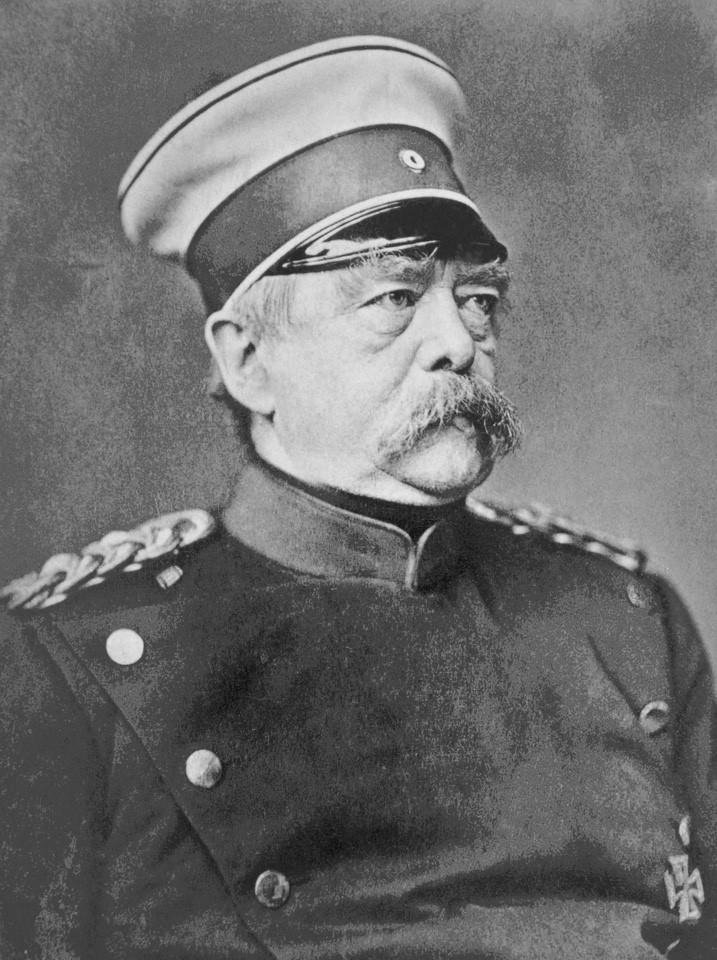
The journey to the unification of Germany was led by otto von Bismarck; he was one of the influential men in the 19th century who played a decisive role in German history from the years 1862 to 1890. Under his command through 3 small scaled wars paved the way for the unification of Germany. He was a fierce opponent of the revolution of 1848 and thus was in a full space of the Prussian authorities. He was appointed in the capacity of chief Prussian delegate to the confederations Diet at Frankfurt in 1851.
But then the Crimean war happened which put great powers at loggerheads with each other, Great Britain and France against Russia. Involvement in the war could prove costly, Bismarck calculated for alignment with any of the power would alienate the other. That’s why when Austria in 1856 projected a proposal to the Diet for sporting Hapsburgs “self-serving role in the conflict “and thus preparing German Confederation forces for this purpose. Bismarck made the point very strongly that neither Prussia nor any other non-Austrian state could get any benefits from this war; his advice was listened to and troops were not mobilized. Great powers were unhappy with Austria and it had to lose some possessions in Northern Italy.
Bismarck assured king William he could brought reforms in military without pleading to parliament or invoking a new revolution. In his famous speech to the Prussian legislature he said that “great questions of the day determined … by iron and blood”. Schleswig-Holstein controversy led to another milestone of German unification this to dickies since the times of Middle Ages what ruled by Denmark, they were not part of Denmark but under the rule of Danish royal house. Nationalist on their part of the world demanded a change in status. Similarly, on this side do to Vienna accord off 1815 which ruled that Holstein should become board of German Confederation and Schleswig would remain outside. Secondly, they were insisted on making both part of unified Germany though most of the people in Schleswig was German not in Holstein. It soon beat trumpets of war and German Nationalists made it an issue of national self-determination, but great powers involved in it to keep the balance of power in the region. British PM Disraeli said about this attitude, “that Dreamy and dangerous nonsense called German nationality”.
The Danish lost the war and the two provinces were divided between Austria and Prussia. Where Prussia had Schleswig and Austria got hold of Holstein. However, Austria was not comfortable ruling a province that is 600 miles from its capital.
From 1864 to 1866 both Austria and Prussia contested for more power-space in the diplomatic games but this one soon turned into conflict when Austria tried to isolate Prussia by preparing reforms like creation of Schleswig-Holstein province and an attempt to join South German states to join Austrian protection Tariff. Prussia defeated Austria in a single combat at Battle of Koniggratz and it also claimed the areas of Hanover, Hessen, and Frankfurt and Southern states as well and appropriated Schleswig-Holstein.
At international level, A Spanish throne question provided an opportunity to Prussia to garner more support for some Southern German states. Actually, Spanish factions picked Leopold Von Hohenzollern-Sigmaringen from the Prussian royal family. Though the prince was not in line of the throne in Prussia, but he was the first nephew of King William I and that was not acceptable to France it led to Franco-Prussian war which proved significant in the wars of in the road to unification. The military glory attained in the war against France had made Prussia able to append Alsace-Lorraine from French territory and an enormous sum of 5 billion francs then this led to the transformation of North German Confederation into the second German Reich.
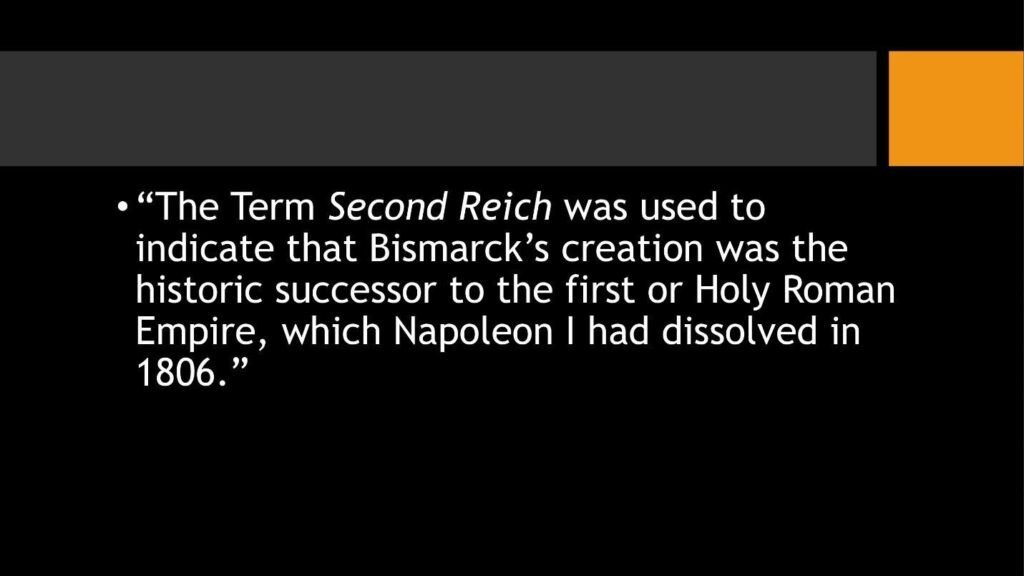
This is new Empire was the brainchild of Bismarck and German people had little role in forming the
Foundations of a new empire. In very clear terms, this has made the Prussian narrative against revolutions very true and a dominant idea as well. Many construed it as God’s help in the establishment of it.
Unification was hardly a solution to the convoluted problems besetting Germany in both pre-1871 and post -871 Germany because in the upcoming decades with the exceptions of few heydays there was a “generation-long depression”.
This founder’s generation began to relieve in the “glories of history” it was even apparent in the architecture of that era for builders build railroads like pseudo-gothic cathedrals” and post offices are like “Renaissance palaces”. The German middle-class depicted emotional dependence on the military. They showed utmost respect for uniforms and military etiquettes were pervasive even in the civic organizations and professors began to model themselves like drill agents.
Another escape from the problems brought by modernity was ant-Semitism. It was borrowed heavily from “pseudo-racial theories” by Count Gobineau. Jewish “evils” were attributed to the entire ethnic race of Jewish people. Some suggested that the solution to the issue of “Jewish problem” is to roll back the developments being made in their immigration and freedom from legal hard rocks. Though at this point the campaign was not unique to Europe alone and it was not strictly” virulent”.
In 1871 there were about 41 million residents in Germany who were on the brink of changing from agriculture to modern industry and manufacturer work and within a period of ten years the majority accommodated themselves in these modern forms of employment. This process of modernization brought modifications to the political and social areas of public life as well. For instance, political parties’ representatives of labor also emerged on the scene. Liberal parties appealed to the mainly middle-class voting section of the people.
Then Germany was being unified along the lines of Kleindeutsch Catholics were not only a minority but also due to the campaigns of “anti-clericalism” and “anti-Catholicism” were waged by “liberal and Marxist parties”. It gave the reason of formation of Centre Party. A large majority of Germans stuck with one of the four parties: The Liberals, the Conservatives, the Catholics, and the Socialists. But the real winner is the Social Democratic party of Germany (SPD).
The second Reich’s constitutional structure was what can be called the Bismarck Compromise. It served three purposes: Maximizing power for Bismarck, Conservative alternative with liberal economic outlook, and Denial of power to Catholics and socialist ideologies. This constitution was more like the North German Confederation which was authored by Bismarck and some German princes. Royal family became the heir to the throne of the German Reich. King of Prussia was also the king of the New Reich. A national “Bicameral legislature” to be elected by male suffrage and Bundhustratwhich had delegated from various states. Bismarck and agreed to this because he knew that he could ignore the legislative authority in the enactment of his political programs.
Social and labor policies of the empire are the indicator of contradictions in the approach of the empire. On the one hand there were inculcations of these policies and on the other the suppression of those political groups who can be in a beneficial position as a result of this. Few of them were anti-Semitic too as shown by the education minister belonging to the conservative party, Adolf Stocker who considered Jews to be the reason behind excessive Marxism and industrialization of German society and the issues that emerged with it.
For Bismarck and his ally’s Marxism is the real threat to the established order due to three reasons,
- Overthrow of capitalism by “lawful means”
- Worker’s association with other workers in other countries
- This trend gave them outlook of international conspiracy
The Empire had passed some socialist laws but it still faced a lot of troubles that needed revision along the structural lines. But the era of Bismarck was coming to an end. Throughout his tenure he enjoyed a special relationship with King William I. This had to change because the king died in 1888 and his son Frederick III replaced him. Soon this king died too.
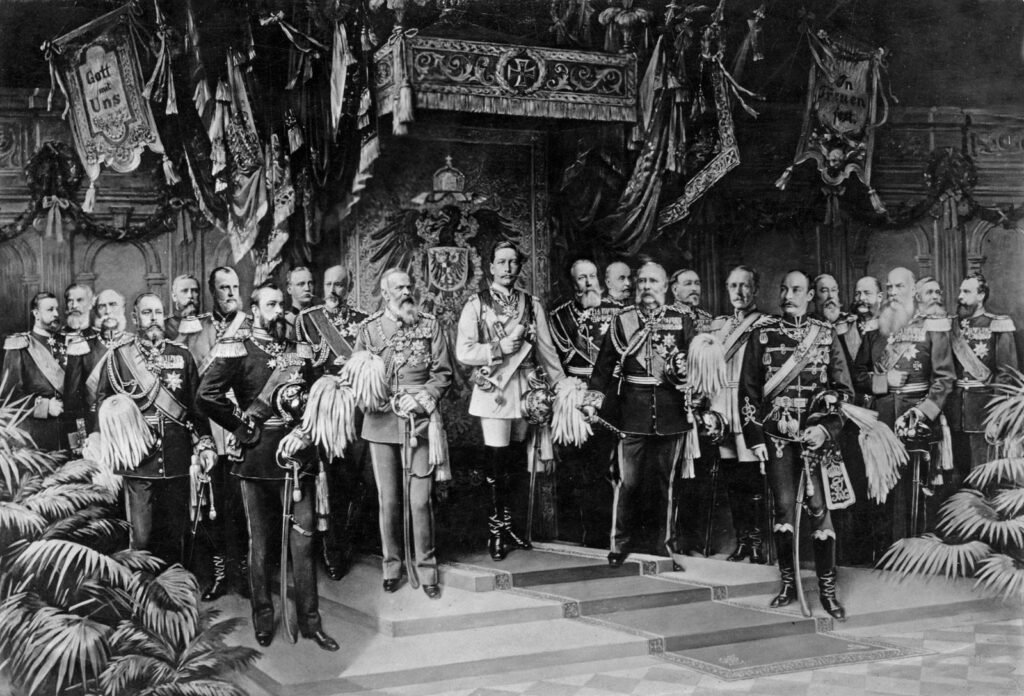
Coronation of William II, 1888.
And a younger King William II, a 29-year-old succeeded him. The young King was arrogant and his wife, Princesses Victoria, daughter of Queen Victoria of Great Britain, were more inclined toward “liberalism and political modernization”. Bismarck never really enjoyed the relationship he had with King William I again with his heirs. In a conflict about Anti-socialist laws, Bismarck resigned. And this brought an end to enduring legacy of man to an unexpected stop in 1890.